
The New Risk Every Traveler Needs to Know
Air transportation is one of the most technologically advanced modes of transportation in the world. From air traffic control and airport operations to airline software, navigation technology, and baggage systems and passenger processing, hundreds of interconnected systems are required for every flight. For travelers, most of this technology remains invisible, that all changes when things go wrong.
A major airport’s technical failure can cause hundreds of flights to be delayed, disrupt travel between countries, and leave thousands of passengers stranded. Issues that start in one control room can impact aircraft, crews, gates, and baggage and airports miles away.
The digital systems that power an airport have been disrupted in recent times, raising a new concern for modern travelers: What happens when the digital systems that power an airport suddenly go offline?
A single technical issue can cause a worldwide disruption
Airports are a network of interconnected airports. A flight that arrives at one airport can be scheduled to depart from another airport a few hours later. The aircraft crew, passengers and baggage need to be moved between the terminals. If one component fails, the impact can be felt throughout the system. Technical issues with air traffic management can limit the number of aircraft that can safely pass through an area. Airlines then have to postpone their flights, reroute flights or cancel services, the result is a chain reaction. A passenger could be flying to a different airport from the one where the issue first arose, and their flight could be delayed because the aircraft or crew they are travelling on is stuck at another airport.
Technology is essential for modern airports
Airports are today essentially a vast technology ecosystem. Digital infrastructure is critical to the passenger check-in, boarding passes, security processing, baggage handling, and gate allocation, as well as flight information systems. Airlines also use advanced systems for aircraft scheduling, crew management, maintenance and route planning behind the scenes.
Air traffic control is another vital layer
Controllers must have reliable communication, surveillance and navigation systems to safely control aircraft in increasingly congested airspace. These systems work perfectly and passengers don’t think about them. If they fail, the whole airport can come to a virtual halt in a matter of moments, air Traffic Control is especially important, Controllers coordinate aircraft as they take off, land and travel through controlled airspace. Their systems ensure safe separation between aircraft and maintain the increasingly complex flight networks. If there is a technical issue, it doesn’t mean that all flights need to be cancelled. Rather, authorities can limit the number of aircraft that can fly through the impacted airspace. This seems like a relatively easy task, but aviation networks are quite busy and have little spare capacity.
Even a small decrease can cause delays that last for hours
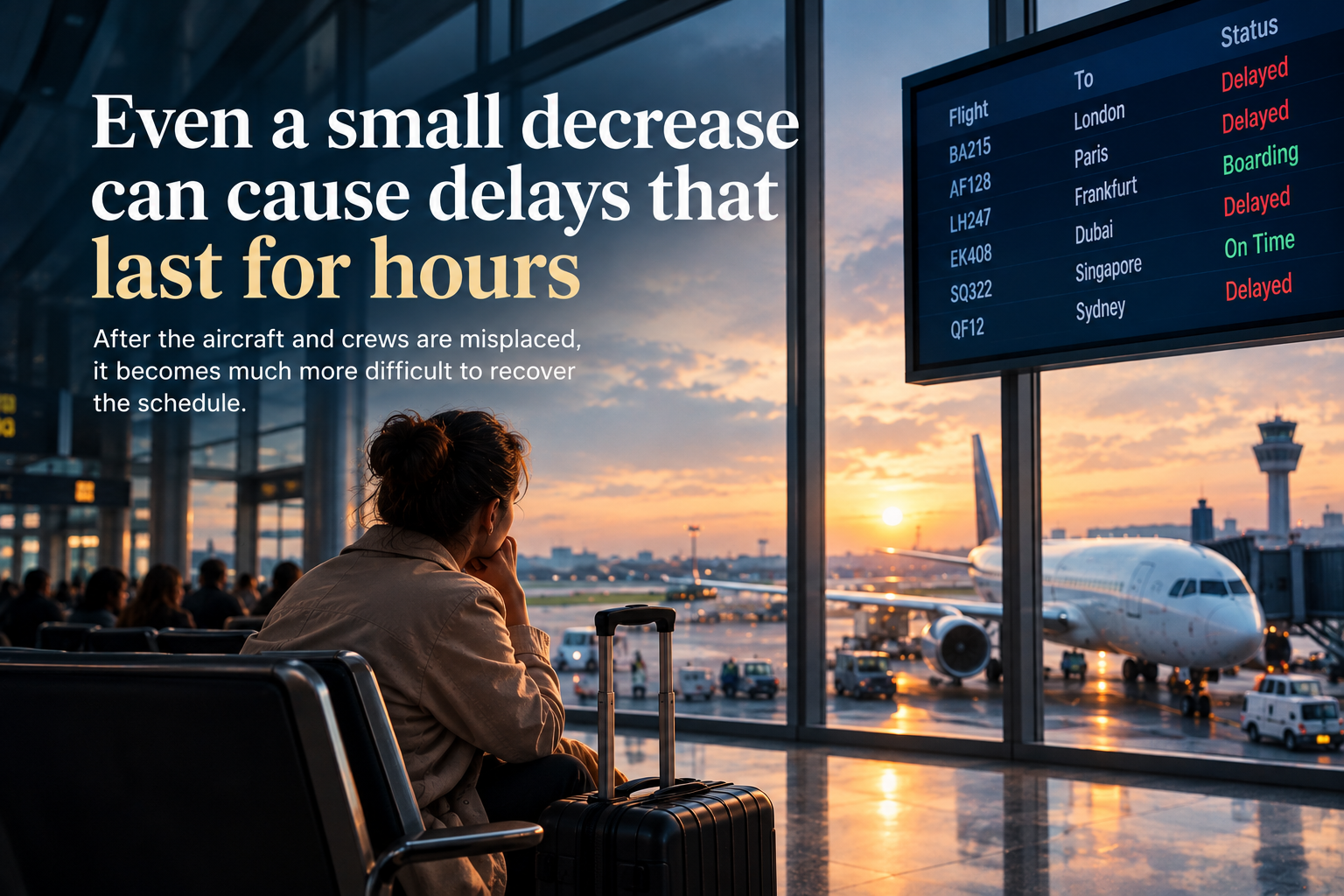
After the aircraft and crews are misplaced, it becomes much more difficult to recover the schedule. This is the reason why delays persist even after the system is fixed. This is the reason that delays persist even after the system is fixed. The worst thing for passengers is to see that a technical issue has been fixed, but flights are still delayed, This is because aviation is a connected schedule. Suppose a plane is booked to fly from London to Paris, Paris to Rome, and then Rome to Dubai. If the first flight is delayed for several hours, the plane might not be able to take off on the next flight. The crew may also attain their legal working limit.
Connections can be missed and bags can be lost from their original flight. Once the initial problem is gone, airlines still need to rebuild the schedule. That’s why a brief technical outage can cause disruption for a whole day or more.
Airports are increasingly becoming digital
The digitalization trend is not abating. Airports are implementing biometric boarding, automated passport controls, digital baggage systems, artificial intelligence and more and more connected infrastructure. These technologies can make travelling quicker and easier. Airports will have fewer physical documents for passengers to navigate. Automated systems can handle many travelers. Data can be used to optimize scheduling and operational efficiency for airlines. But increased digitalization also creates a new dependency. The more systems are interconnected, the more critical the importance of resilience becomes. An efficient airport is useful, but an airport that can still function in the event of a technological failure is even more useful.
The risk of cybersecurity is another risk
Technical failures are not always a random occurrence. Airports, airlines and other transportation networks are now facing another threat from cyberattacks. If a successful attack is made on a critical aviation system, it could cause disruption to operations, compromise data, or cause organizations to temporarily shut down systems. It doesn’t mean that travelers should presume that all airport outages are cyberattacks. There are many possible causes for most technical failures. As the aviation industry increasingly relies on digital infrastructure, however, cybersecurity has become a critical component of aviation safety and resilience. Airports need to safeguard systems while simultaneously maintaining backup operations in the event of a digital infrastructure compromise.
The navigation system is a new challenge for the navigation systems
One new issue is the interference of satellite navigation. Satellite-based positioning and navigation technologies are critical to modern aviation. Aviation authorities are concerned about the growing number of GPS and other satellite-navigation interference. There are several navigation and safety systems built into an aircraft, and if they lose satellite positioning, it does not necessarily mean that the flight is unsafe. There are procedures for pilots and air traffic controllers to follow in the event of a navigation disruption. However, the more interference that is added, the more it shows how modern aviation can be impacted by technological and geopolitical changes that extend beyond an airport.
Human Expertise Still Matters

While technology is transforming airports, humans are still vital. If automated systems fail, experienced personnel must be able to know how to switch to backup procedures. Air traffic controllers must find ways to control aircraft other than the traditional way. Airline staff must interact with passengers, reschedule flights and deal with flight cancellations.
When required, airport teams must manage the flow of passengers and baggage and gates manually.
- This translates to training being as critical as technology.
- The best aviation systems are not those that presume that computers will never fail.
- They are systems built on the premise that something will.
What does this imply for travelers?
While passengers have no control over the infrastructure of an airport, they can minimize the effects of disruptions. A great tip is to give yourself more time between flights, a seemingly convenient connection on a regular day can be a big issue when an airport is disrupted. Travelers should also not make very tight travel plans around events of significance. If you have a wedding, business meeting or cruise departure that is not to be missed, coming a day early could be beneficial. It is also a good idea to keep essentials like medication, documents and basic necessities in hand luggage. A late checked bag can be a further issue in the event of a significant airport disruption.
Travel insurance is gaining importance
Travel insurance has traditionally been associated with medical emergencies, cancellations and lost baggage. Disruption from operational failures and extreme events are also becoming a factor for travelers to consider increasingly. There are huge differences in policies and travelers should be aware of what they are actually covered for before buying. Some policies may include some delays or extra accommodation charges, others may have specific exclusions. Having insurance is not the key, It’s understanding what protection you have, airlines are becoming more resilient. Minimizing disruption is a strong financial incentive for airlines. Each cancelled flight may result in further expenses such as aircraft, crew, accommodation, compensation for passengers and customer service. That’s driving airlines to invest in improved forecasting and operational technology. AI can be used to forecast potential disruptions and to optimise aircraft and crew schedules. A more flexible fleet plan can also enable airlines to recover more quickly from unforeseen issues. The goal is shifting from “disruption prevention” to “rapid recovery from disruption.
Can AI be used to prevent future outages?
AI could play a significant role in aviation resilience. AI systems can sift through vast amounts of operational data and detect issues before they escalate into significant disruptions. Predictive systems, for instance, could detect maintenance problems, predict congestion, or help airlines to reposition aircraft and crews more efficiently. AI can also assist airports with passenger flow management in the event of disruption. AI relies on infrastructure, however. In the event of failure of the underlying systems, an AI solution can also become unavailable. This implies intelligent technology and strong backup systems will be required for future aviation systems.
Travelers will have to think differently

Modern travelers are used to very accurate timetables. Flight apps provide real-time updates. Digital boarding passes replace paper boarding passes. Airport processing is faster with automated systems. This convenience can lead to unrealistic expectations, however. Air travel is still a complicated physical system that spans across countries, weather, aircraft and human teams. Technology can help make that system more efficient, but it cannot make it entirely fail-proof. Travelers might then have to get used to uncertainty. Flexibility in key trips may be as significant as the lowest airfare.
The New Meaning of Airport Resilience
The future airport will not be evaluated just on the basis of how fast it can move passengers on an average day. It will also be evaluated by what happens when things go wrong.
- Will flights still be able to fly if one system fails?
- Are staff able to transfer to alternative procedures?
- Are passengers able to get correct information?
- Are airlines able to recover schedules rapidly?
Will airports be able to operate in the event of a cyber attack, navigation disruption or significant power outage? As aviation moves towards a more digital environment, these questions are gaining in significance.
The Future of Air Travel
Technology has made air travel more connected, more efficient and faster than ever. That same technology has opened new doors of vulnerability, however. One system failure can impact thousands of passengers well beyond the point of the initial failure. But it does not mean that travelers should be afraid of flying. Despite the many safety measures and redundancies in place, aviation is still one of the safest modes of transport in the world. The lesson is that resilience is as important as efficiency in modern air travel.
The capacity to function in the event of a technology failure will be one of the most critical indicators of a successful aviation system as airports become more digital. The lesson for travelers is just as easy: The next big disruption to air travel might not be due to weather or mechanical issues. It could begin with a system going offline.
